



Nehemiah 8, the Fall Feasts, and a People Hungry for God’s Word
By ICEJ USA Managing Editor Karen Engle
Discover how Nehemiah 8 points directly to the prophetic fulfillment of the Fall Feasts.
In 586 BC, King Nebuchadnezzar and the Babylonian army destroyed Jerusalem’s walls, burned the city to the ground, and took the Jewish people captive into Babylon. During their time in exile, the people had little to no access to the Scriptures, and regular, public instruction in the Law had largely fallen by the wayside.
However, by decree of Cyrus the Great in 538 BC, the Jewish people were released to return home. Though the temple was restored under Zerubbabel and Joshua, Jerusalem’s walls lay in ruins for over 140 years until they were finally rebuilt in 445 BC.
With the temple restored and the walls rebuilt, Nehemiah 8:1 says the entire assembly of Israel gathered as “one man” (a Hebrew idiom meaning “united”) in the open square in front of the Water Gate. Ezra brought the sacred scrolls before the people, whose hearts were finally ready to hear and obey God’s Word. Nehemiah 8:2–3 says:
Ezra the priest brought the Law before the assembly of men and women and all who could hear with understanding on the first day of the seventh month. Then he read from it in the open square that was in front of the Water Gate from morning until midday, before the men and women and those who could understand; and the ears of all the people were attentive to the Book of the Law. (Emphasis added)
“The First Day of the Seventh Month”
Nehemiah 8:2 says this happened on the “first day of the seventh month.” This might seem like unimportant information. However, it’s a time marker that, when understood in its proper context, illuminates the significance of what was happening that day in Jerusalem.
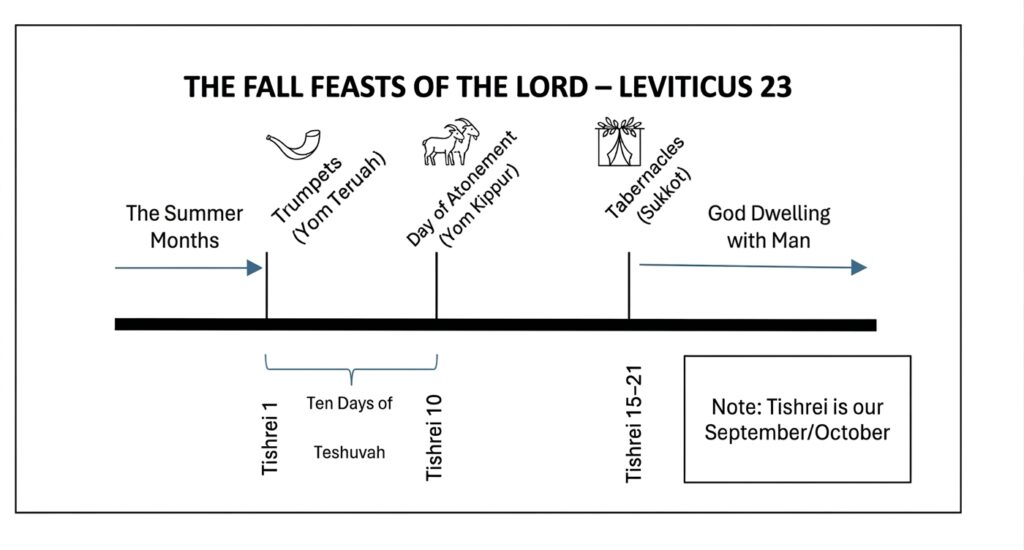
The first day of the seventh month on God’s biblical calendar was the month of Tishrei, and that date happened to be the Feast of Trumpets—Yom Teruah, or the “Day of Trumpet Blowing.” This feast, or “appointment,” is the only feast that God orchestrated to begin at the sighting of the new moon, or the beginning of a new month. Because of this, in ancient biblical times (with no internet for tracking calendars like today), no one knew for sure the exact day or hour the Feast of Trumpets would occur.
Thus, this feast became known in Judaism as the “hidden” day.
And this feast kicked off a unique season in the collective life of the nation of Israel.
A Season of Spiritual Renewal
Historically and today, Jewish tradition views the period from the Feast of Trumpets through the Feast of Tabernacles as the ultimate season of spiritual renewal—a sacred succession of fall feasts commanded in Leviticus 23.
Today, this special day on the first day of the seventh month, the Feast of Trumpets, launches a 10-day period of intense soul-searching, repentance (teshuvah in Hebrew), and reconciliation with God that culminates on the Day of Atonement (Tishrei 10).
In ancient Israel, once atonement was secured, the somber focus shifted dramatically to the Feast of Tabernacles—from solemn introspection to joyful celebration: it was a time of giving thanks for God’s physical protection, harvest blessings, and His desire to dwell among His people. The same holds true today.
A Posture of Brokenness
A few verses later in Nehemiah 8, as Ezra read from the book of the Law, verse 6 says the children of Israel lifted their hands in praise and worshiped God “with their faces to the ground”—a posture of brokenness, humility, and worship. And as he read, others, including the Levites, “gave the sense, and helped them to understand the reading” (v. 8).
Note in verse 9 how the people responded:
Nehemiah, who was the governor, Ezra the priest and scribe, and the Levites who taught the people said to all the people, “This day is holy to the Lord your God; do not mourn nor weep.” For all the people wept, when they heard the words of the Law.
As the people heard God’s word and as the Levites helped them understand what was being read—on the Day of Trumpets—God opened their spiritual eyes. As they realized that all this time, they had not been following God’s instruction and had grieved Him with their disobedience, they wept.
Yet Nehemiah encouraged the people not to mourn, weep, or sorrow, declaring to them “the joy of the Lord is your strength” (v. 10). The section ends with the Levites quieting the people and saying: “Be still, for the day is holy; do not be grieved” (v. 11 emphasis added).
Dwell in Booths
With their new understanding, the people’s attitude completely changed:
Now on the second day the heads of the fathers’ houses of all the people, with the priests and Levites, were gathered to Ezra the scribe, in order to understand the words of the Law. And they found written in the Law, which the Lordhad commanded by Moses, that the children of Israel should dwell in booths during the feast of the seventh month, and that they should announce and proclaim in all their cities and in Jerusalem, saying, “Go out to the mountain, and bring olive branches, branches of oil trees, myrtle branches, palm branches, and branches of leafy trees, to make booths, as it is written.”
Then the people went out and brought them and made themselves booths, each one on the roof of his house, or in their courtyards or the courts of the house of God, and in the open square of the Water Gate and in the open square of the Gate of Ephraim. So the whole assembly of those who had returned from the captivity made booths and sat under the booths; for since the days of Joshua the son of Nun until that day the children of Israel had not done so. And there was very great gladness. Also day by day, from the first day until the last day, he read from the Book of the Law of God. And they kept the feast seven days; and on the eighth day there was a sacred assembly, according to the prescribed manner. (Nehemiah 8:13–18, emphasis added)
The people of Israel now understood the significance of where they were on God’s calendar. It was the day after the Day of Trumpets, “the second day,” and they realized the Feast of Tabernacles—the final fall feast on God’s annual calendar—was on Tishrei 15, just 13 days away. Recognizing they had not been keeping God’s commandment to dwell in booths (sukkahs) for seven days, they prepared to gather branches of olive, myrtle, palm, and leafy trees to build temporary shelters with roofs open to the sky, as instructed in Leviticus 23:39–43.
This unique feast, which wrapped up the festival season, recalled God’s presence dwelling with His people in the wilderness and filling the First Temple—but it also looked forward to the day when He would dwell among them again. Though they had initially mourned at the realization of their past disobedience, the Levites reminded them that the time for mourning was over.
And as Moses had commanded for the Sabbatical year in Deuteronomy 31:10–13, Ezra read aloud from the Law each day during the seven-day Tabernacles celebration, culminating in a solemn, sacred assembly on the eighth day (Nehemiah 8:18) where they enjoyed intimate fellowship with their Creator.
The Fulfillment of Trumpets and Tabernacles
In Colossians 2:16–17, Paul explains that God’s feasts are a “shadow” of things to come, but the substance—the ultimate reality—is found in Christ. While Jesus fulfilled the spring feasts down to the exact day during His first coming, the fall feasts point forward to His return, when He will once again dwell among His people and rule from Jerusalem.
Though we can only speculate about the details of that future Day of Trumpets, Nehemiah 8 gives us a prophetic picture of how God will deal with national Israel in the end times. Notice the pattern in what happened in Nehemiah 8:
- When the people truly understood God’s Word, they collectively recognized their sin and wept in deep repentance.
- Their sorrow was quickly transformed into “very great gladness.”
- The remnant returned from Babylon joyfully observed Tabernacles, dwelling in booths for seven days—just as God instructed.
- Ezra read aloud from the Book of the Law each day of the feast.
- On the eighth day, the nation gathered for a final “sacred assembly.”
Nehemiah 8 offers us a preview or “snapshot” of an event described by the prophet Zechariah. A day is approaching when God will remove the veil from Israel’s eyes, allowing them to finally see their Messiah clearly. Just like the prodigal son, Israel will return to the Father in collective grief and repentance and embrace Jesus—the living Word, the living Torah—for who He truly is:
I will pour on the house of David and on the inhabitants of Jerusalem the Spirit of grace and supplication; then they will look on Me whom they pierced. Yes, they will mourn for Him as one mourns for his only son, and grieve for Him as one grieves for a firstborn. (Zechariah 12:10)
Israel, God’s set-apart nation created to bring salvation to the ends of the earth (Genesis 12:3), will listen and learn to fear the Lord their God. Now filled with the Spirit, they will be able to “carefully follow all words of this law” (Deuteronomy 28:58), just as the prophet Jeremiah had foretold:
“This is the covenant I will make with the people of Israel after that time,” declares the Lord. “I will put my law in their minds and write it on their hearts. I will be their God, and they will be my people. No longer will they teach their neighbor, or say to one another, ‘Know the Lord,’ because they will all know me, from the least of them to the greatest,” declares the Lord. (Jeremiah 31:33)
Isaiah says there is a coming day when the Law will go out from Zion (2:3). On that day, just as Ezra read the Law daily during Tabernacles from Jerusalem, the Word of the Lord—Jesus, the Word made flesh—will teach all nations directly from Jerusalem during His messianic reign.
And just as Israel gathered for that eighth day sacred assembly after the feast had ended for a time of deep communion with her God, humanity will step past the temporal realm into eternity—the ultimate “eighth day”—where God will tabernacle or “dwell” with man forever in the New Jerusalem.
On that day there will be no more sorrow, tears, or death (Revelation 21:3–4), and Jesus will rule and reign with grace, mercy, and justice.
Watch the Feast of Tabernacles 2026 online, live from Jerusalem!
Related Articles
The Restoration of Israel in the Feast of Tabernacles
The Prophetic Secret of God’s Calendar and Leviticus 23
Understanding the Spring Feasts and Why They Point to What’s Ahead
God’s Calendar–and How It Impacts Our Understanding of the Prophetic Timeline
Aviv Barley and the Start of the Biblical Year
The Summer Months on the Biblical Calendar