



Ark of the Covenant: Meaning, History & Mysterious Disappearance
By ACLI Coordinator Shelley Neese
The ark of the covenant is the most revered—yet least understood—sacred object in the Hebrew Scriptures. Misunderstandings stem from the ark’s inherent paradoxes. The ark was a material throne for the immaterial God. By its very design, it was a container, yet it was built to represent the God of the universe, who could not be contained.
On the right day and by the right person, the ark unlocked the key to God’s mercy, but if the wrong person, on the wrong day, or with the wrong spirit, approached the ark, it unleashed God’s wrath. God allowed it to be used as a weapon of war at Jericho, where no combat occurred, but He hated when the Israelites used it as a good luck charm in the Battle of Aphek.
Despite these paradoxes, the ark has had a permanent effect on the spiritual imagination of Bible readers, an influence strengthened by the fact that the Bible says nothing about what happened to it, does not grieve its loss, and never predicts its return.
Building the Ark of the Covenant
The ark’s story begins in the wilderness of Sinai. After the dramatic events of the Exodus, God summoned Moses to the top of the mountain, where He revealed to His faithful servant the conditions of His covenant. In addition to the many statutes that would guide and protect the relationship between God and His chosen people, He gave Moses a divine blueprint for the tabernacle and its furnishings (Exodus 24–31). God commanded Him to “make Me a sanctuary, that I may dwell among them” (Exodus 25:8). The directions are both opaque and incredibly specific.
An Act of Creation
Before construction began, Moses and Aaron took up a collection of materials: precious metals, fine fabrics, oils, incense, and acacia wood. They asked the freed slaves to donate voluntarily as their hearts led them. The budding nation gave so generously that Moses had to send word throughout the camp that the architects had more than they needed. The building of the tabernacle was their first national group project. Rabbi Jonathan Sacks notes, “Just as the universe began with an act of creation, so Jewish history (the history of a redeemed people) begins with an act of creation.”1
From Courtyard to Holy of Holies
Inside a curtained courtyard stood a large bronze altar for animal sacrifices and a bronze basin for the priests to wash their hands and feet. The first room contained a pure gold menorah, the table of the bread of the Presence, and an altar of incense. Behind an inner veil lay the Holy of Holies, a cubic inner sanctum housing the ark.
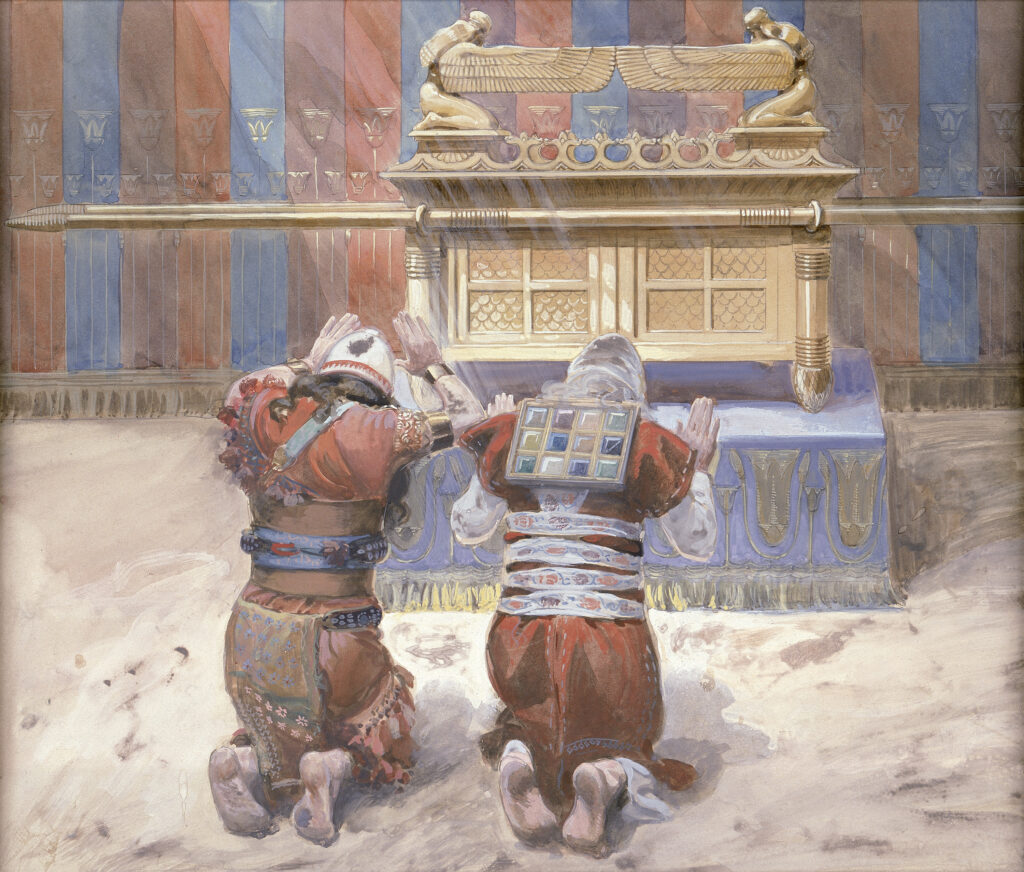
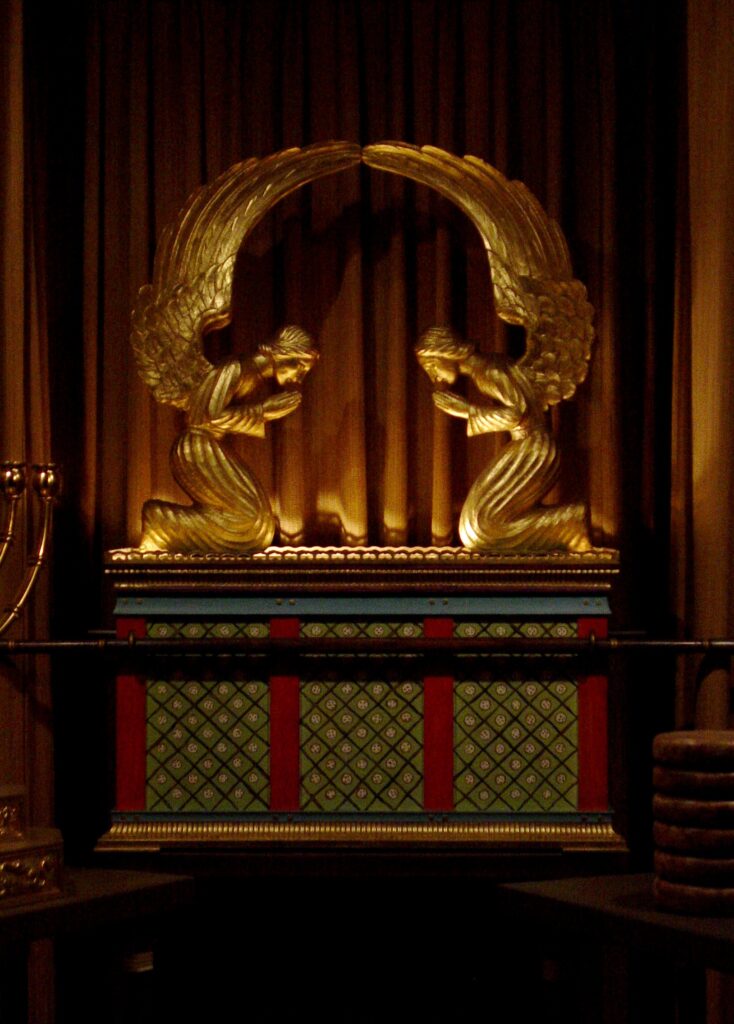
The artisan Bezalel fashioned the chest from acacia wood and overlaid it inside and out with pure gold. Following the biblical dimensions, the ark was two and a half cubits long, a cubit and a half wide, and a cubit and a half high—roughly four feet in length and over two feet in width and height. The ark’s lid was the mercy seat, a solid slab of pure gold. Flanking it were two sculpted cherubim of hammered gold whose outstretched wings overshadowed the cover, their faces turned inward toward each other.
What Is Inside the Ark of the Covenant?
In biblical Hebrew, ‘edut (עֵדוּת) is shorthand for the stone tablets inscribed by the finger of God on Mount Sinai. Biblical writers refer to them as “the tablets of the testimony” (luchot ha-’edut, לוּחֹת הָעֵדֻת) or simply “the testimony” (ha-’edut, הָעֵדֻת). When God commands Moses to place “the testimony” inside the chest, he refers to these stone slabs. Exodus, Leviticus, and Numbers frequently call the acacia chest the “ark of the testimony,” emphasizing the chest’s physical contents. By contrast, from Deuteronomy through Chronicles, the acacia chest is most often referred to as the “ark of the covenant.” By that phrasing, the whole ark, and not just its deposit, is the seat of God’s reigning authority.
Scripture presents an apparent tension regarding what else accompanied those stone tablets. In Exodus 16:34 and Numbers 17:10, Moses directs that the jar of manna and Aaron’s budding staff be placed “before the testimony”—phrasing that suggests they either rested inside the ark or on the floor directly in front of it. Looking back on the wilderness wanderings, the author of Hebrews locates all three items inside the chest: the urn of manna, Aaron’s staff, and the tablets (Hebrews 9:4).
However, in the account of Solomon dedicating the First Temple, 1 Kings states that “there was nothing in the ark except the two tablets of stone that Moses had placed there at Horeb” (1 Kings 8:9). The tumultuous history of the ark between the time of the wilderness wanderings and its placement in the First Temple accounts for the jar and staff’s disappearance. Across nearly a hundred years of military catastrophe, forced transit, and rough handling, the manna and wood disappeared. By the time Solomon installed the ark within the inner sanctuary of his temple, only the stone tablets remained.
Egyptian Parallels
Over the last two centuries, archaeologists working in Egypt have identified artifacts that closely resemble the biblical description of the ark of the covenant. The closest historical parallel comes from the fourteenth-century BC tomb of Pharaoh Tutankhamun. Among Tutankhamun’s burial treasures was a wooden chest covered with gold and measuring almost the same size as the ark of the covenant. Just as the biblical ark had metal rings and long poles for the priests to carry it, so too did the shrine. Instead of cherubim, a statue of the Egyptian god Anubis topped the chest.
Bible readers should not be disturbed by any similarities between Ancient Near Eastern artifacts and holy objects described in the Bible. In fact, Egyptian finds illuminate the Bible’s descriptions and provide historical context.Since the Israelites had lived in Egypt for many generations, they had become a people skilled in building and craftsmanship. Bezalel and his fellow artisans had learned their technical skills—ranging from fine carpentry and gold leafing to metal casting—from Egyptian masters.
When God called Bezalel to build the sanctuary, He poured the divine spirit into Him so that those same skills could be used for holy service (Exodus 31:1–5). God intentionally used familiar artistic and architectural terms. In doing so, God took the artisans’ previous skills, redeemed them, and turned the tools of their former bondage into instruments of worship.

The Travels of the Ark of the Covenant
Before the ark of the covenant found a resting place in Jerusalem, it journeyed alongside Israel from the period of wandering to their final settlement. Whether in battle or in eras of peace, the ark reminded them of God’s nearness.
Through the Wilderness & Conquest
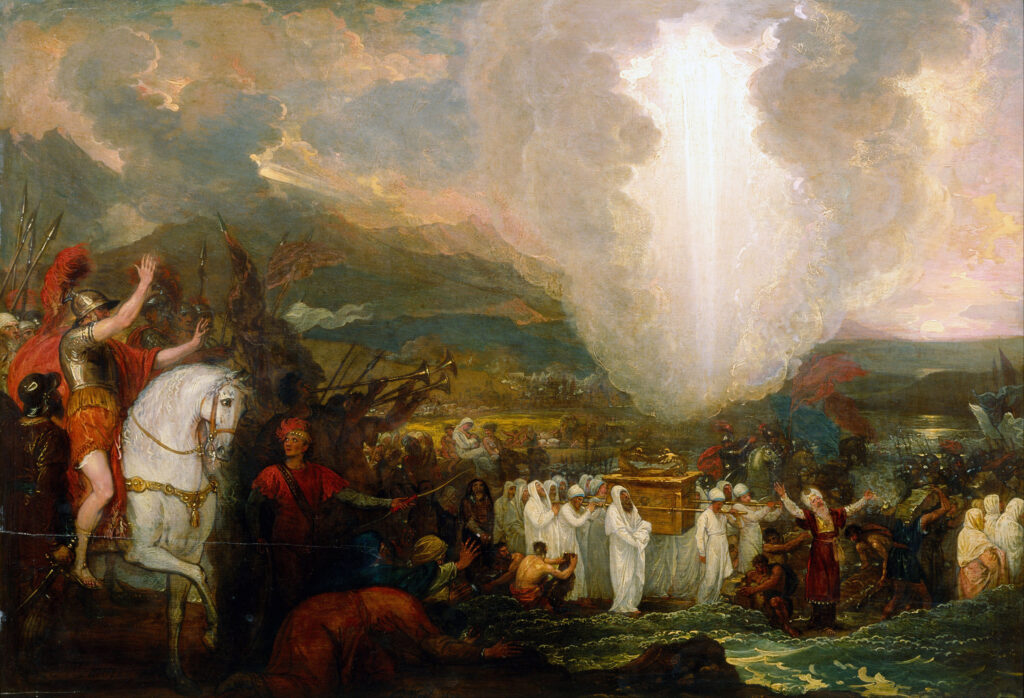
Throughout the 40 years of wilderness wandering, each time the Israelite camp needed to march, the ark set out first and Moses declared, “Rise up, O LORD! Let Your enemies be scattered, and let those who hate You flee before You” (Numbers 10:35–36). When the people departed the plains of Moab and finally crossed over into the promised land, the priests carrying the ark of the covenant led the way.
As soon as they entered the flooded Jordan River, the waters at once receded so that the people could cross on dry ground. At the Battle of Jericho, the ark was responsible for another miracle. The priests marched the arkaround the city, and the massive stone walls collapsed without a single Israelite having to draw his sword.
From Shiloh to Mount Zion
After the period of conquest, Israel established its first permanent spiritual center in the hills of Shiloh. For four centuries, during the turbulent period of the judges, the ark stayed at Shiloh.
When King Saul came to power, he largely ignored the ark, treating it only as an occasional good luck charm in battle (1 Chronicles 13:3). However, once David took the throne and established his royal capital in Jerusalem, he was eager to install the ark on Mount Zion (2 Samuel 6). To King David, the ark of the covenant was God’s earthly footstool (1 Chronicles 28:2). David burned with desire to build God a house, a thing of beauty to both glorify God’s name and be filled with His glory.
Solomon’s Temple
When construction of the First Temple was complete after seven years of labor, Solomon assembled the elders, tribal leaders, and priests of Israel to dedicate it during the Feast of Tabernacles (1 Kings 8:1–9). The priests brought the ark of the covenant into the inner sanctuary. A dense cloud filled the house of the Lord, making it impossible for the priests to continue ministering. Even though Solomon built the temple to house the ark, he also recognized that an omnipresent God could not be spatially contained. Standing before the bronze altar with his hands spread toward heaven, Solomon prayed, “Behold, heaven and the heaven of heavens cannot contain You. How much less this temple which I have built!” (1 Kings 8:27).
For nearly four centuries the ark stayed safely inside the inner sanctuary, although the biblical account suggests that later idolatrous kings either removed the chest or desecrated the holy rooms with pagan images (2 Kings 21:4–7; 2 Chronicles 35:3).
What Happened to the Ark of the Covenant?
In both 597 and 586 BC, the Babylonian army marched on Jerusalem. Fed up with the Judahite crown’s repeated defiance and broken treaties, they encircled the city, overran Jerusalem’s protective walls, and pillaged the temple’s treasury. In the first raid, they cut all the golden ritual vessels into pieces (2 Kings 24:12–13). In the second attack, Nebuchadnezzar took the bronze pillars and bronze basin with its stands, all the bronze sanctuary utensils, and the precious metal objects used in temple service (2 Kings 25:13–17). In the meticulous inventory of the spoils of war, the biblical authors never mention the ark of the covenant. If the ark had been stolen, it would seem to be at the top of the list.
The silence regarding the ark’s fate has led to centuries of rabbinic head-scratching. Some sages of the Talmud maintained that the chest had been taken to Babylon.2 If that were the case, the ark is forever lost to history. The other, more hopeful, possibility was that King Josiah and the loyal priests secreted the ark from the inner sanctuary into the Temple Mount’s complex network of underground vaults.3 Outside the canon, texts such as 2 Maccabees and 2 Baruch state that the prophet Jeremiah saved the ark of the covenant and other sacred furnishings by burying them in a secret cave and sealing the entrance.4
Whatever happened, the ark never resurfaced or was reconstructed. When Jewish exiles returned from Babylon and rebuilt the Jerusalem temple, they left the Holy of Holies empty for six centuries.5 On Yom Kippur during the Second Temple period, the High Priest entered the Holy of Holies four times, stepping into an inner sanctum completely bare of the ark of the covenant. The High Priest sprinkled the blood of the bull and then the sacrificial blood toward the Foundation Stone that once supported the ark.6
The priests performed the entire atonement liturgy as if the golden ark were still present. When the Roman general Pompey entered the Holy of Holies in 63 BC, expecting to find an idol or sacred image of the Jewish God, he was shocked to find the sanctuary completely empty.7
Eden Restored
In the years that the tabernacle stood in the wilderness, Moses would enter the sanctuary to speak with the Lord, hearing the divine voice from between the two cherubim above the ark (Numbers 7:89). The image of Moses hearing God’s voice issuing from the cherubim evokes Eden. It points back to the days in the garden when God first spoke to the objects of His creation. Just as Adam and Eve once walked with God in the garden, Moses had special, regular access to God’s presence.
When Adam and Eve rebelled, God stationed cherubim and a flaming sword at the east of Eden to bar the way to the tree of life (Genesis 3:24). With the ark, that Edenic imagery is redeemed. The ark’s cherubim representedthe restored access to the Holy One. Even if that access was limited to Moses and the High Priest, the long-torn relationship between God and humanity was being mended. The tabernacle and, later, the First Temple, were the first steps in a divine rescue plan. They represented a localized Eden in a fallen world.
The prophets never anticipated the ark of the covenant’s return. If anything, the prophet Jeremiah says the opposite: “It shall not come to mind, nor shall they remember it, nor shall they visit it, nor shall it be made anymore”(Jeremiah 3:16). Jeremiah foresaw the day when all “Jerusalem shall be called The Throne of the LORD, and all the nations shall be gathered to it, to the name of the LORD, to Jerusalem” (Jeremiah 3:17).
Conclusion
From the wilderness wanderings to the inner sanctum of the First Temple, the ark represented God’s longing to dwell among his people, restoring the Edenic intimacy between the Creator and His creation. The ark was never meant to be a lost relic or a biblical paradox. It was the start of a promise. The same God who spoke to Moses from between the golden cherubim would send someone greater than Moses—His Son—to declare the end of spiritual exile.
The author of Hebrews describes Jesus as the High Priest who bypassed the earthly, handmade tabernacle to enter the “greater and more perfect tabernacle not made with hands” (Hebrews 9:11–12). The apostle Paul used the Greek word for the mercy seat to describe the saving work of Jesus’ bodily death and resurrection. Jesus was the one “whom God set forth as a propitiation [hilastērion, mercy seat] by His blood, through faith, to demonstrate His righteousness” (Romans 3:25).
Six centuries after the ark disappeared, God sent a living mercy seat, and this time He was not hidden behind a veil. Jesus became the true meeting place where divine justice and divine mercy converged. He was the repository of the new covenant, the source of eternal redemption, and the final sacrifice.
1 Jonathan Sacks, Exodus: The Book of Redemption, Covenant & Conversation (Jerusalem: Maggid Books, 2010), 200.
2 Babylonian Talmud Yoma 53b; Shekalim 6:1. (Rabbi Eliezer argued the ark was exiled to Babylon, citing 2 Chron 36:10 and Isa 39:6).
3 Babylonian Talmud Yoma 52b, 53b; Horayot 12a; Keritot 5b; Tosefta Sotah 13:1. (Rabbi Judah and Rabbi Simeon maintained that King Josiah hid the ark, along with the jar of manna and Aaron’s staff, beneath the Temple Mount based on 2 Chronicles 35:3).
4 2 Maccabees 2:4–8; 2 Baruch 6:7–10. (2 Maccabees describes Jeremiah hiding the tent, the ark, and the altar of incense in a cave on Mount Nebo; 2 Baruch attributes the concealment of the sacred vessels to an angel before the Babylonian breach).
5 Babylonian Talmud Yoma 21b (listing the ark, mercy seat, and cherubim among the five things missing in the Second Temple).
6 Mishnah Yoma 5:2–4; Babylonian Talmud Yoma 53b–54a; Tosefta Yom ha-Kippurim 2:14.
7 Tacitus, Histories 5.9.1; Josephus, Jewish War 1.152; Antiquities of the Jews 14.71–72.
Related Articles
17 Verses about Jerusalem in the Bible
A New Covenant (Video)
The Tabernacle in the Desert: A Copy and Shadow of God’s True Sanctuary