



A Faith Journey to Israel: “The Homeland of My Heart”
By John W. Swails III, PhD
This post is excerpted from Susan Michael’s book Every Generation’s Story: 75 Years of American Christian Engagement with Israel, which follows the unique experiences of 18 American Christians representing 5 generations who responded to God’s call to go to Israel—and how it changed their lives forever.
The first time I remember thinking about the modern State of Israel was when I was about 10 years old. I remember flipping through a new encyclopedia set my parents had purchased and seeing the entry for Israel with a picture of an Israeli army jeep. I asked my folks about it, and they reminded me that they had told me about the recent establishment of the Jewish State. Clearly, it took some time for that reality to register in my mind.
For some time, my interest did not extend beyond a passing curiosity, despite news items and current events concerning Israel. The next step in the development of my engagement with Israel came when I was 13. In February 1962, Oral Roberts came to our home in Franklin Springs, Georgia, to recruit my father, and he gathered my parents, my two brothers, and me in our living room to present what he envisioned for the university now known as Oral Roberts University (ORU).
I remember two points he made that day: first, that ORU would have a national championship basketball team, and second, a branch of the university would be established one day in Israel. After his visit, my dad told me about several other times Oral had spoken about his desire to do something in and for Israel. In retrospect, considering these experiences, it seems odd that I continued to be unconcerned about Israel and its people—and the plans of the Almighty for the same. …
In 1964, my father made his first trip to Israel. He returned with impressions that solidified into a firm conviction: he would not rest until he had taken his whole family to Israel. In short, he accomplished this—and so much more.
My father’s commitment to bringing his family to Israel led to plans for a tour that would include my mother and me. Our departure date was to be June 5, 1967. That became a historic day for the State of Israel as it was the start of the Six Day War. My mom woke me up that morning with the news that war had broken out in the Holy Land, so our trip was canceled. Since it was uncertain whether the tour could be rescheduled that year, I enrolled in summer school at the University of Georgia. Subsequently, when it did become possible for the group to go in July, I was in class and could not join them.
…
My first trip to Israel was an expedition that took three weeks, covered fourteen different countries, and included eight days in Israel—a tour led by my father and our next-door neighbor, John Noseworthy. My roommate was my good friend from Franklin Springs, A. D. (Doug) Beacham, Jr. Doug and I set off with great excitement in anticipation of an epic tour. Our group went through Europe to Moscow and then to Cairo, Egypt. But when attempting to depart Egypt from the old Cairo West Airport, we learned that our flight to Beirut, Lebanon, had been canceled because the “omens were wrong.” While waiting in the desert airport for several hours in the heat without bottled water, we became desperate for some form of hydration.
Fortunately, a vendor passed by with a cart full of ice and oranges; we all bought fresh orange juice, which was incredibly sweet and refreshing. However, we soon began to pay the price for that refreshment as gastrointestinal distress afflicted members of our group in quick succession. My symptoms started during the flight from Beirut to Cyprus, and by the time we flew from Cyprus to Israel, I was suffering and feeling quite sorry for myself. As we approached Israel, I was dozing while still aware of my pain and abdominal distress.
However, as soon as the plane touched down at Lod Airport, it was as if a mild electrical charge zapped me; I still recall the intense sensation vividly, even today. I sat up and looked around, my symptoms began to recede, and a sense of excitement and enthusiasm replaced my focus on my physical issue. I am in Israel. I’ve come home! I thought. I continued to marvel at that fact for the rest of that trip—and every time I have spent time in the Land since.
A Still, Small Voice
At one point during that first trip to Israel, we had a free day in Jerusalem. My dad asked what I wanted to do with the time. I had been impressed by the Hebrew University campus during our brief visit during the tour, so I told my dad I wanted to revisit it.
As we walked from the bus stop onto the campus, the words came into my mind: “Why don’t you come back here next year as a student?” I repeated those words to my dad, who responded positively, and the next thing I knew, we had detoured to the office for overseas students and started the process that would bring me back to the Land in 1969. It was a complex process in those days, especially compared to the relatively easy process students go through today to study in Israel.
Back home, I applied to several graduate schools where I could study the Ancient Near East—the context in which the Bible was written. I was accepted and received offers of fellowship money from more than one. However, when I visited the school making me the best offer, I realized it was not the right school for me. I then met with my dad at a camp meeting where he was speaking, and as we walked and talked, he turned to me and said, “It looks like you should go to Hebrew University.” I nodded, and it was settled. They had offered generous funding for the Summer Ulpan, where I would learn modern Hebrew, so it was now just a matter of preparing for the trip.
However, before preparing for the trip, … I had to deal with what could have been a significant complication. I was engaged to be married to Joy Williams from North Carolina, and I now had to explain this decision to her. To her lasting credit, she received the news well and encouraged me in my course. The same Spirit was leading her as me, and this mutual leading has continued to mark our relationship as we have been married for over 50 years. Joy’s commitment to the leading of the Spirit and Israel would be a vital part of our lives and would even include giving birth to one of our children in Jerusalem.
The Homeland of My Heart
Off I went to Hebrew University with a group sponsored by the American Friends of Hebrew University. When I met the other 400 students at an orientation in New York City, I realized they were all Jewish. It would be several weeks into our stay in Israel before I discovered three other Christians in the group. Finally, after two days of meetings in New York City, we boarded the plane for Israel, arriving late in the afternoon. …
After we landed and retrieved our luggage, students started protesting that buses were not waiting for us upon our arrival. Amid the turmoil, an Israeli madrich (counselor) walked up and spoke in Hebrew. I looked at him for explanation, and he said: “Don’t worry—you are home.” I can’t describe the effect those words had on me—I can still feel it. All the noise and confusion receded into the background, and a sense of peace and belonging settled in—a sense quite real even today. … His words dug into my heart and have remained lodged there ever since. They are the reason I teach students to learn about and travel to Israel. I tell my students: “Israel is the homeland of your heart, and it is also the frontline of history.”
We eventually boarded buses and headed off into the desert. Our dormitories in Jerusalem were incomplete, so we began our language studies at a midrasha (institute for Torah studies), which was located next to Kibbutz Sde Boker where David Ben-Gurion, the first prime minister of Israel and an important world figure in the twentieth century, lived in retirement. …
We arrived at the midrasha for the first time at 10:30 p.m. and were shown to our rooms, located around a plaza within a compound. I found myself in a room with four young Jewish men from large cities in the northern United States, while I was from a small southern town of fewer than 500 people—and obviously not Jewish. Nonetheless, that night began an exciting and enjoyable time of cultural exchange and the formation of friendships that exist to this day.
Learning from Ben-Gurion
I had the opportunity to hear Ben-Gurion speak on more than one occasion. He was 83 at the time and still walking vigorously every morning and evening for considerable distances. His mind was exceptionally sharp, and his remarks and interactions with people and their questions were impressive.
What impressed me most was the fire that still burned inside him. That “fire” propelled him through difficult and dire situations, fueled his immense energy and courage, and undergirded his vision for Israel. Undoubtedly, meeting and hearing from David Ben-Gurion was transformative in my life. Ben-Gurion’s vision for Israel was biblically based. He believed the prophet Isaiah’s words that Israel was to be “a light for the nations” (Isaiah 49:6 ESV). I heard him say this several times and always with the same conviction and confidence. He had an appreciation and respect for Scripture that went beyond his contemporaries and guided his thinking and life. I believe he would be pleased to see how Israeli innovations in science, medicine, and technology benefit the world today.
Ben-Gurion was also committed to settling the desert, and he emphasized that commitment every time I heard him speak—and it is also why he retired and chose to be buried there. He would have been overjoyed to witness the signing of the Abraham Accords II at Sde Boker Kibbutz in the spring of 2020. So as often as I can while in Israel, I visit his grave at Sde Boker and put a stone of remembrance on his cover stone to pay respects to a great human being whose impact on my young life has only increased with time.
A Lifelong Passion
Ever since my first trip to Israel as a teen, my life has been focused on Israel, the Jewish people, and the Almighty’s love for His people. My 40 trips to the Land—twice for extended periods (one of which included the birth of our youngest son, Joel, in Jerusalem)—have only intensified that focus.
Yet through the years, I’ve wondered about the strangeness of it all. Though I periodically questioned whether I should alter the direction of my life, I relate to the apostle Paul’s words: “I was not disobedient to the heavenly vision” (Acts 26:19). My work has always been motivated by an irresistible call and vision from God—and because of this, it will always focus on Israel.
As a professor of history and government and the director of the Center for Israel and Middle East Studies at ORU, I have taught well over a thousand students about the history and significance of Israel. I have traveled to Israel 40 times, 17 of which were study trips. I have also served several pro-Israel organizations in an advisory capacity, such as the International Christian Embassy Jerusalem (ICEJ), Christians United for Israel (CUFI), and the American Israel Public Affairs Committee (AIPAC).
And although I love teaching, I am always ready to return to Israel. The refrain of an Israeli song by Yehoram Gaon says, “I am the man who is always returning.” Those words have become my life motto.
See Israel for yourself! Join a life-changing ICEJ tour to Israel.
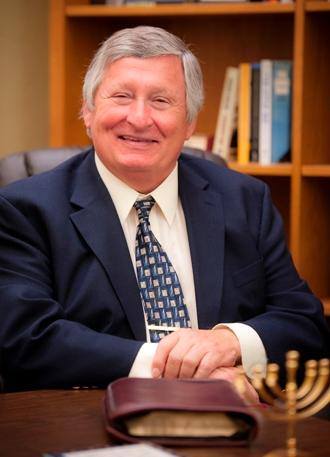
John W. Swails III, PhD, is the director of the Center for Israel and Middle East Studies at Oral Roberts University in Tulsa, Oklahoma. He has degrees from the University of Georgia in Modern Jewish History and the Modern Middle East and from Brandeis University in Ancient Near East Studies. He teaches courses on modern Israel, World War II and the Holocaust, the Ancient Near East, radical Islam, and the Islamic Middle East.
Related Articles
Gentiles in God’s Plan of Redemption
Do Gentiles Have a Role in the Restoration of Israel?
Simeon in the Bible: Why We Must Have “Eyes of Expectation”
Zechariah’s Prophetic Visions: A “Righteous Remnant”