

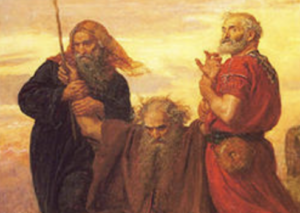
Exodus 17 tells how Amalekites, descendants of Esau’s grandson, attacked the children of Israel in the desert of Sinai during their exodus from Egypt. This unprovoked attack was especially serious and the Israelites battled all day, only achieving victory at nightfall.
In response to this demonstration of cruelty, the Lord told Moses that He would blot out the remembrance of Amalek from under heaven. Moses later recounted: “The Lord will have war with Amalek from generation to generation” (Exodus 17:16). Amalek’s attack on the children of Israel was now a perpetual war between him and the God of Israel.
Amalek was not just a foe, but a genocidal one, so in Jewish tradition the Amalekites came to represent the archetypal enemy of the Jews present in generation after generation. It is interesting to note that some one thousand years later, in the book of Esther, the arch villain Haman was an Amalekite who led the plot to kill the Jews.
The Longest Hatred
This evil pursuit of the Jewish people has continued for millennia, which is why historian Robert Wistrich calls antisemitism “the longest hatred.” Every time this genocidal hatred seems to be dying out it reinvents itself with a different look and a different name. But the goal is always the same: to rid the world of the Jewish people.
In the ancient world, classical anti-Semitism was a clash between pagan rulers, who demanded obedient homage, and their Jewish subjects, who would only worship and obey the God of Israel. The Jewish people could not bow down to earthly leaders, and were bound by the Sinaitic Law to certain behaviors and observances that set them apart and incurred the wrath of their rulers.
Religious Antisemitism
After the rise of Christianity the problem did not go away. It is a travesty that antisemitism was then found in the heart of Christian Europe. Indeed, in the annals of those who persecuted and hated the Jewish people are professing Christians. Space does not permit a full treatment of this sad story, but centuries of state and church-backed denigration, persecution, forced conversions, and expulsions actually paved the way for the Holocaust.
Proof of this is found in the fact that Martin Luther’s antisemitic writings were published and distributed by the Nazis in order to justify their anti-Jewish laws and eventually their extermination program. Hitler admitted as much when he told two Catholic bishops who questioned his policy that “he was only putting into effect what Christianity had preached and practiced for 2,000 years.”
Racial Antisemitism
The form of anti-Semitism found in Nazi ideology was not based on religion, however, but on racial theories about the superiority of the Aryan race. Whereas Christianity had sought the conversion of the Jews, and state leaders had sought their expulsion, the Nazis sought the “final solution to the Jewish question,” the murder of all Jews and their eradication from the human race.
For decades following World War II, society viewed these older forms of antisemitism as socially unacceptable, as explicit religious bigotry and biological racism were widely rejected across global civic life.
Political Antisemitism and Anti-Zionism
However, antisemitism did not disappear; it mutated. Today, the modern form of antisemitism that has found a stronghold and large-scale acceptance is political. It is directed against the Jewish nation-state and presents itself as anti-Zionism.
At the same time, religious antisemitism remains prevalent throughout the Islamist world, providing the rationale for genocidal rhetoric and proxy warfare targeting Israel. Too often, this hostility is tolerated or rationalized by Western commentators who blame it entirely on Israeli policies.
Not all criticism of Israel can be considered antisemitic. However, criticism of Israel crosses the line into antisemitism—as outlined in the widely accepted International Holocaust Remembrance Alliance (IHRA) working definition—when it delegitimizes the State of Israel and denies its right to exist, applies double standards not demanded of any other democratic nation, uses classic anti-Jewish stereotypes or comparisons to the Nazi regime, and serves as a pretext to harass or attack local Jewish individuals, synagogues, and communal institutions.
While these dynamics were visible during regional escalations such as the 2014 Gaza war, they exploded into an unprecedented crisis following the October 7, 2023, Hamas attack on Israel. In the months that followed, the global surge in antisemitic hostility reached historic highs—manifesting in violent threats on college campuses, attacks on synagogues, and an unprecedented wave of online harassment across North America and Europe.
While America has historically served as a vital safe haven for Jewish communities fleeing global persecution, record-high levels of antisemitic incidents across the United States demonstrate that low levels of hatred can no longer be taken for granted.
As Christians, we should take every opportunity to stand in solidarity with the Jewish community—attending Holocaust remembrance events, condemning attacks on local Jewish institutions, and teaching the next generation to recognize antisemitism and take a stand against it.
This generation’s battle is not so much with the Amalek of old, and its ancient pagan, medieval religious, or twentieth-century racial antisemitism, but with the Amalek of today—the rabid anti-Israel movement that demonizes the Jewish people and nation while excusing or enabling antisemitic hatred.
This battle is happening on our watch, and it is our responsibility to stand against it.
Dr. Susan M. Michael is US President for the International Christian Embassy Jerusalem – USA Branch.