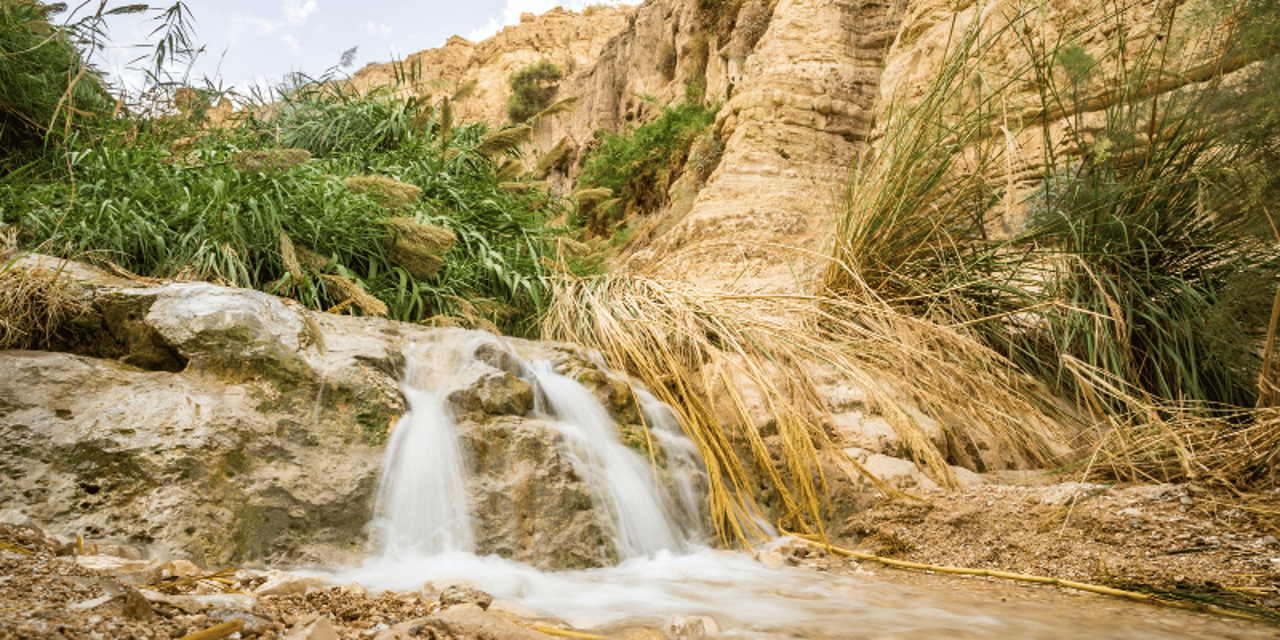
Imagine traveling through the barren wilderness beside the Dead Sea—dry, hot, and seemingly lifeless. Then, a lush oasis emerges from the desert, almost unexpectedly, with water flowing from the rocks and palm trees bearing dates swaying in the soft breeze.
This is En Gedi.
For thousands of years, En Gedi (also spelled Ein Gedi) has been a place of life, refreshment, and refuge. It was here that David found shelter while fleeing from King Saul and faced a defining moment of trust in God. The story of En Gedi reminds us that even in the driest seasons of life, God can provide a place of refuge and renewal.
To understand why this oasis became so significant in the biblical story, let’s first discover where En Gedi is and why this remarkable place has mattered for thousands of years.
Where Is En Gedi?
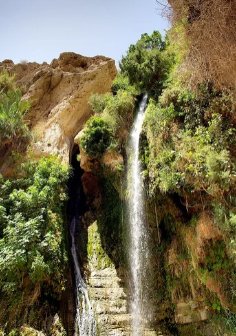
En Gedi is quite the surprise in the middle of the desert. It is the largest oasis along the Western shore of the Dead Sea. This area that has been inhabited because of fresh springs since the Chalcolithic period (3,500 BC) was given to the tribe of Judah and was famous in the time of Solomon. Three waterfalls cascade from the high rock into shallow pools, making En Gedi a refreshing sanctuary during a dry and hot Middle East climate.
What Is the Meaning of En Gedi?
The name En Gedi translates from Hebrew to mean “spring of the kid.” Because of its continuous freshwater springs, this area draws animals like gazelles, deer, badgers, and wild goats. Therefore, En Gedi translates from Hebrew to mean “spring of the kid." Beyond the native wildlife, humans have made their way to En Gedi for centuries to take relief and refuge.
Historically speaking, from 3,500 BC, there remained a Canaanite temple sitting on a cliff above Nahal David. No houses were present during this time, so it was believed that nomads passing through would use the temple. The springs had been used for centuries, but while the water source was well known, the area was not settled until the end of the seventh century BC, when an Israelite fortress was built. The Babylonians pursued and destroyed the fortress before the destruction of Jerusalem in 586 BC. Following the Babylonian destruction, however, the area was resettled by Jewish exiles returning from captivity in Babylon.
Where Does En Gedi Appear in the Bible?
1. Abraham and the Patriarchal Era
During the patriarchal period, the name of the area was Hazazon-Tamar and, according to Genesis 14:7, Abraham came there claiming victory against the four Mesopotamian kings on his way. En Gedi was later given to the tribe of Judah where shepherds would bring their sheep for rest and nourishment.
2. David and the Strongholds of En Gedi
Around 1,000 BC, this place served as one of the main places of refuge for David as he was being chased by King Saul. The En Gedi terrain was steep with deep limestone caves, offering David natural high-ground defenses and hidden vantage points. It is here David quite possibly wrote Psalm 18 and Psalm 32 in response to being pursued by King Saul while in En Gedi:
The Lord is my rock and my fortress and my deliverer, my God, my rock in whom I take refuge; my shield and the horn of my salvation, my stronghold. (Psalm 18:2)
You are my hiding place; you will protect me from trouble and surround me with songs of deliverance. (Psalm 32:7)
A powerful story that took place here is when David cut the corner of King Saul’s mantel or prayer shawl off (Tzitzit), representing his power or authority being taken from him. It is no wonder that King Saul would be amazed that David did not take his life, but symbolically, his authority:
He came to the sheep pens along the way; a cave was there, and Saul went in to relieve himself. David and his men were far back in the cave. The men said, “This is the day the Lord spoke of when he said to you, ‘I will give your enemy into your hands for you to deal with as you wish.’” Then David crept up unnoticed and cut off a corner of Saul’s robe. (1 Samuel 24:3–4 NIV).
God Almighty delivered David from death promising kingship for him in the future. He provided David with a hiding place and protection. Imagine being on the run and hiding for years. The canyon of En Gedi served as a rock and fortress for David.
3. En Gedi in Song of Solomon and Prophecy
King Solomon compared his lover to “a cluster of henna blossoms from the vineyards of En Gedi” (Song of Songs 1:14). And the prophet Ezekiel predicted fishermen would line the shores of the Dead Sea by En Gedi (Ezekiel 47:10).
4. The Roman Era and the Jewish Revolt
This heaven-on-earth became very important during the Roman period. It was a wonderful place to gather dates and balsam for perfumes. Josephus praised En Gedi for her palm trees and springs.
During the First Jewish Revolt in AD 66, the Sicarii—the Jewish faction driving the rebellion—raided the town and killed 700 people. Though devastated, the area was resettled by the end of the first century. It thrived as a Jewish settlement, complete with a synagogue, until the sixth century AD.
Spiritual Lessons from En Gedi Today
Maybe you need refreshment or protection today. Maybe you need a fresh start. Maybe you need God to step in and rescue you from something or someone. The story of En Gedi reveals that God is your source of life, safety, and protection, just as He was for David in this beautiful oasis in the Middle East.